Practical Ways to Lower Your LLM API Costs
Understanding Where the Costs Come From
Every call to a large language model API burns through tokens, input tokens for the prompt and output tokens for the generated text. Most providers charge per token, but the real price you pay depends on more than just the list rate. Request volume, model choice, and how you structure your calls all shape your final bill. If you are building an application that relies on frequent API calls, even small inefficiencies add up fast. The good news is that you can reduce spending without sacrificing quality, as long as you know what to look for.
Step 1: Choose the Right Model for Each Task
The first and most effective lever is model selection. Not every request needs the largest, most capable model available. For straightforward tasks like summarization, classification, or simple content generation, a smaller or older model can deliver perfectly acceptable results at a fraction of the cost. Many providers offer several tiers of models, each with different token pricing. Before you send a request, ask yourself: does this task genuinely require high reasoning power, or can a cheaper model handle it?
Watch out for overfitting your application to a single model. It is easy to pick a powerful model during development and then never revisit that choice. As your usage grows, the cost difference between a premium model and a budget model can become enormous. Regularly audit which models you call and for what purpose. Some developers set up a routing layer that automatically sends simple queries to a cheaper model and only escalates complex ones to the expensive model. This kind of intelligent routing can cut your monthly spend noticeably.
Step 2: Optimize Your Prompt Design
Your prompt length directly affects the number of input tokens consumed. A bloated prompt with redundant instructions, long examples, or unnecessary context burns tokens on every single request. Streamlining your prompts is one of the simplest ways to lower cost. Start by trimming any boilerplate that does not change between calls. If you repeatedly include the same system message, consider caching it on the API side if your provider supports that. Otherwise, keep it as concise as possible.
Also pay attention to output token limits. Many developers set a generous maximum output length without thinking about it. If your use case only needs a short answer, cap the output tokens to that length. You pay for output tokens at the same rate as input tokens, so every extra word you generate costs money. Experiment with shorter outputs and see if they still meet your quality bar. In many cases, they will.
Step 3: Manage Request Volume and Batching
How you schedule and group your requests can influence pricing. Some APIs offer lower per-token rates for higher request volumes or for batch processing. If your application sends many independent requests, see if you can combine them into a single call. For example, instead of making ten separate requests to summarize ten documents, you can send one request with all ten documents and ask for ten summaries. This reduces overhead and may qualify you for better volume pricing.
Watch out for rate limits and usage caps. High request volume can trigger throttling or additional fees on some plans. Keep an eye on your billing balance and set alerts for unusual spikes. A sudden jump in usage might indicate a bug in your code that is sending duplicate or unnecessary calls. Monitoring your request patterns helps you catch these issues before they inflate your bill.
Step 4: Use Cost Monitoring and Budget Controls
You cannot manage what you do not measure. Set up cost monitoring from day one. Many API providers give you dashboards to track token usage and spending, but you can also build your own logging layer that records token counts per request. This lets you see which endpoints, models, or user actions drive your costs. With that data, you can make informed decisions about where to cut back.
Establish hard budget limits if your provider supports them. For example, you can set a monthly cap that stops further requests once your spend reaches a certain threshold. While this might sound extreme, it prevents runaway costs from a misconfigured loop or an unexpected traffic surge. You can always raise the cap later as you gain confidence in your usage patterns.
Step 5: Explore Alternative Providers and Pricing Models
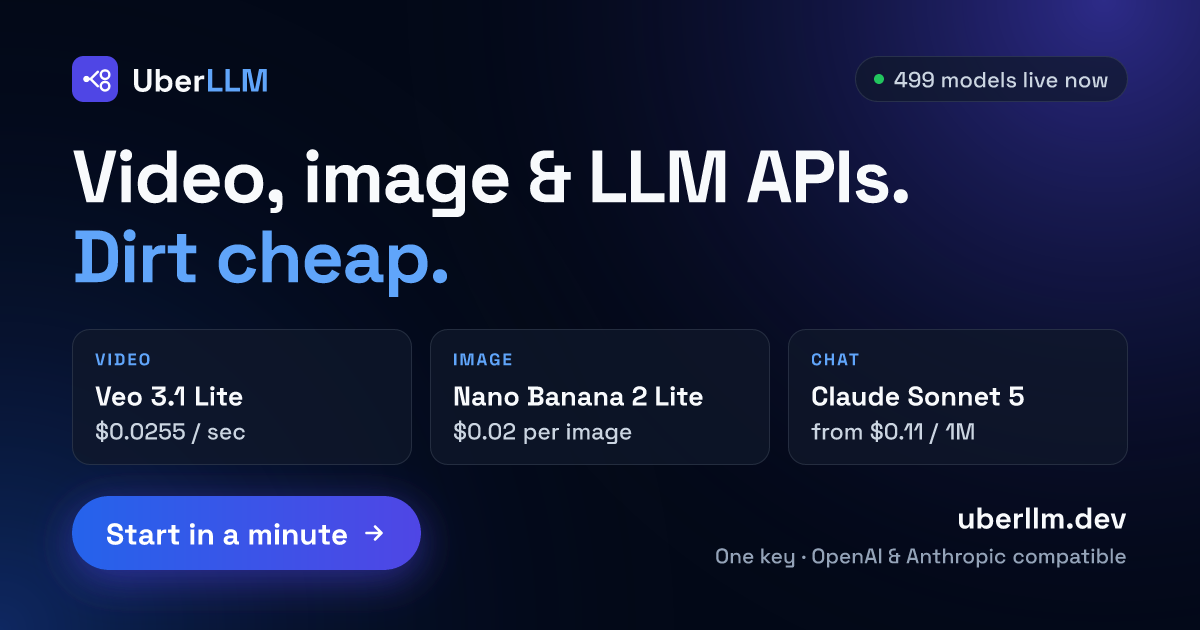
The market for LLM APIs is competitive, and new providers often offer lower rates than the dominant players. Some services aggregate multiple models from different sellers, allowing you to access to lower model rates without committing to a single vendor. This kind of setup gives you flexibility: you can route requests to whichever seller offers the best price for the model you need at that moment. It also means you are not locked into one pricing structure, so you can adapt as your usage changes.
One thing to watch is compatibility. If you switch providers, you do not want to rewrite your entire integration. Look for providers that offer OpenAI or Anthropic compatible APIs, so your existing code works with minimal changes. This reduces migration cost and lets you test new pricing without a big engineering effort. Over time, you can shift more traffic to the cheapest reliable option.
Step 6: Cache Responses Where Possible
If your application makes the same request multiple times, for example, generating a summary of a popular article or answering a common question, you can cache the response and avoid paying for a new API call each time. Caching works best for deterministic or near-deterministic outputs. Store the response keyed by the input prompt and model, and serve the cached result for identical future requests. This technique can dramatically reduce your token consumption for high-traffic queries.
Watch out for cache staleness. Language models can change their behavior over time as they are updated, so set an expiration policy on your cache. Also be mindful of prompts that include dynamic data like timestamps or user IDs. Cache only the parts of your workload that are truly repetitive. For everything else, cache misses are acceptable as long as you keep the hit rate high.
Step 7: Negotiate or Switch to Pay-as-You-Go
For high-volume users, list prices are often negotiable. If you are making thousands of requests per day, reach out to providers and ask for a custom rate. Many are willing to lower the per-token price for committed volume. Alternatively, look for services that charge no subscription fee and no per-request markup. Some platforms let you access to lower model rates by connecting you directly to sellers who compete on price. This model can be especially attractive if your usage is variable and you do not want to commit to a monthly minimum.
When evaluating a new provider, consider the total cost of integration. A slightly higher per-token price might be worth it if the API is easier to use or more reliable. But for many teams, the biggest savings come from reducing the per-token price itself, not from optimizing usage. Combining multiple strategies, model selection, prompt optimization, caching, and competitive pricing, gives you the best chance of keeping your LLM API bills under control.
By following these steps, you can build a cost-efficient workflow that lets you scale your application without watching your budget disappear into token fees. The key is to stay proactive: monitor your usage, experiment with different models and providers, and never assume the first setup you choose is the cheapest one.